The short answer: a good therapy session note records what you targeted, how the child performed against each goal's criterion, with what level of support, and what happens next session. The most common way to organize it is the SOAP format: Subjective, Objective, Assessment, Plan.
Instead of "Good session. Omar worked on /s/ and did well," write: "Omar produced /s/ in the initial position of words correctly in 14 of 20 picture-naming trials (70%), independently, up from 12 of 20 last session. Plan: keep the same target and add 5 trials in short phrases."
The first note can't be measured, compared, or continued by anyone else. The second one can.
Session notes are the link between two other documents. Measurable goals say what you are working toward, and progress reports show families how far the child has come. Session notes are where the data that connects them is collected, one session at a time.
Why Session Notes Matter More Than They Seem
Session notes are often written in a rush between children, so they become the weakest document in the file. But almost everything else depends on them:
- Progress reports: a report can only be as accurate as the session data behind it.
- Continuity: if a specialist is absent or the child moves to a new therapist, the notes are the only record of where the work stopped.
- Clinical decisions: whether to keep, adjust, or change a goal should come from data across sessions, not from memory.
- Accountability: notes show the family, the center's management, and in some cases insurers or authorities what happened in each session they paid for or oversee.
A quick check: if another specialist read only your last three notes, could they run the next session? If the answer is no, the notes are missing something.
The SOAP Format, Section by Section
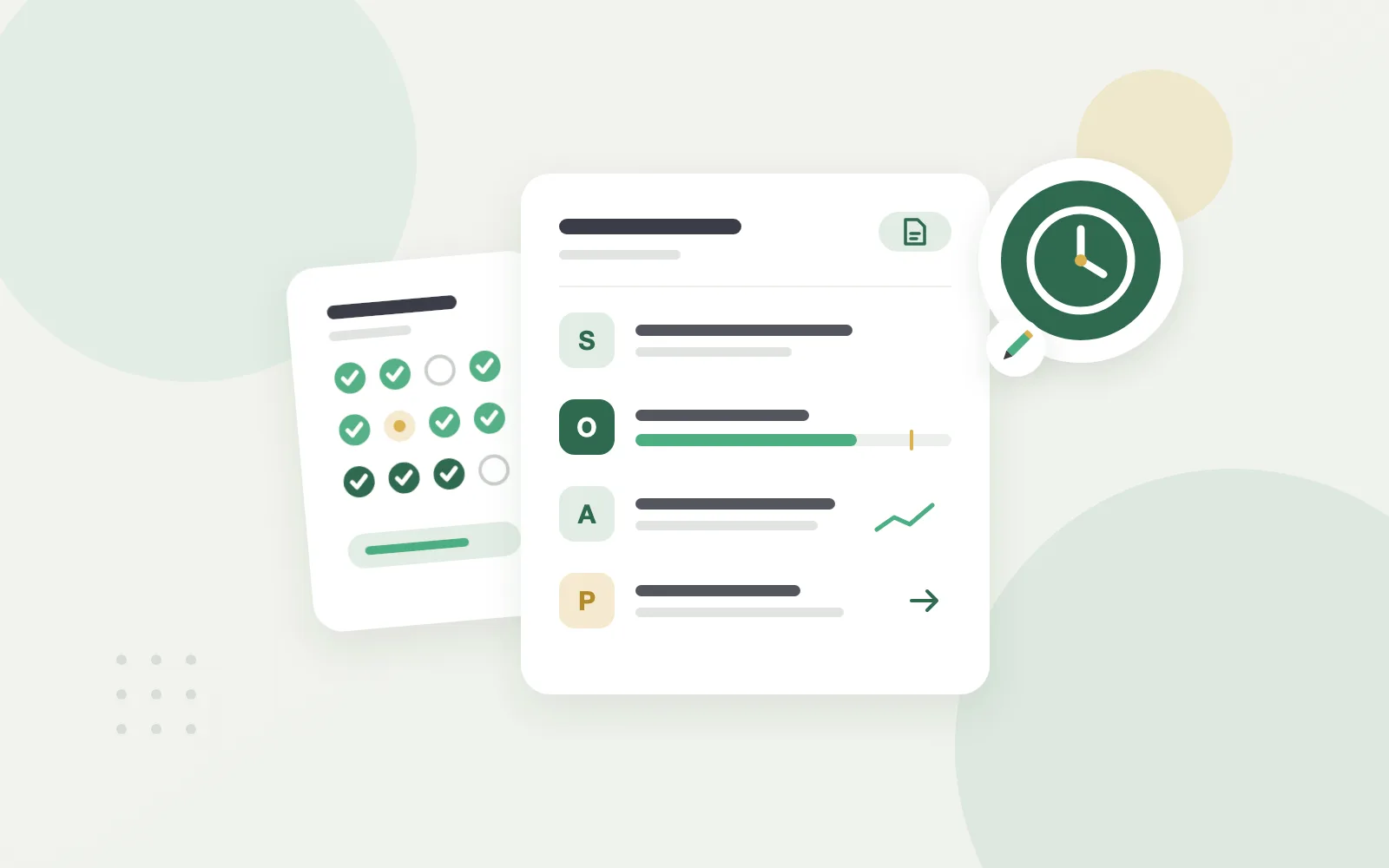
SOAP is widely used in speech therapy, occupational therapy, and other health professions because it separates what was reported, what was measured, what it means, and what comes next. Your center may use a different template, but the same four ideas usually appear in some form.
| Section | What it contains | Example |
|---|---|---|
| S: Subjective | What the family or child reported, and how the child presented today | "Mother reports Omar slept poorly. He entered the room calmly and engaged quickly." |
| O: Objective | What you targeted and measured: data against each goal, level of support, activities | "/s/ initial position: 14/20 (70%), independent. Following two-step directions: 3/5 with gestural cues." |
| A: Assessment | Your professional interpretation: progress compared to previous sessions, and why | "Steady gain on /s/ (60% → 70%). Directions remain dependent on gestures." |
| P: Plan | What happens next: next targets, changes, and home practice | "Continue /s/ at word level, add 5 trials in phrases. Begin fading gestures for directions." |
S: Subjective
Keep it short and relevant. Include information that may affect performance or the plan: sleep, illness, a change in medication or routine, a parent's concern, or the child's mood on arrival. Attribute it clearly: "Mother reports…" rather than stating it as fact.
Leave out details that don't affect the session. The subjective section is not a diary.
O: Objective
This is the core of the note, and it should be written so another specialist could repeat it. For each goal you targeted, record:
- The measure from the goal itself: if the criterion is "4 of 5 trials," record successful trials out of 5, not a general impression.
- The level of support: independent, verbal cue, gestural cue, model, or physical prompt. 70% with physical prompting and 70% independent are very different results.
- The materials or context when they matter: picture cards, a structured game, a group activity.
Observable behavior only. "Was frustrated" is an interpretation. "Pushed materials away twice and said 'no more'" is an observation.
A: Assessment
Here you interpret the data. Compare it to the baseline and to previous sessions, and say what you think explains the result. This is where professional judgment belongs, so keep it brief and tied to the numbers above it.
- Weak: "Doing well."
- Useful: "Accuracy on /s/ has risen across the last three sessions (55% → 60% → 70%). Half of the errors are now on words that start with a consonant blend."
P: Plan
The plan is what turns a note into continuity. Say what the next session will target, what will change (support level, materials, difficulty), and any home practice you gave the family. A plan of "continue" tells the next reader nothing.
Examples: From Vague to Useful
The examples below build on goals from the measurable goals guide. The names and numbers are illustrative. Real notes should reflect each child's own data and your center's documentation policy.
| Vague note | Useful note |
|---|---|
| "Worked on articulation. Good progress." | "/s/ initial position, picture naming: 14/20 (70%) independent, up from 12/20 last session. 3 of the 6 errors on /st/ and /sp/ blends." |
| "Behavior was difficult today." | "Left the table 4 times in 30 minutes (previous 3 sessions: 6, 5, 6). Used the break card independently on 3 of 7 opportunities." |
| "Child followed directions." | "Followed unrelated two-step directions in 3 of 5 trials with gestural cues; 1 of 5 without cues." |
| "Fine motor practice." | "Cut along a 15 cm straight line within 1 cm in 2 of 4 trials, with a verbal reminder to turn the paper." |
| "Mom says he's better at home." | "Mother reports he asked for water with a picture card twice this week without crying (first time reported)." |
A Full Speech Therapy Session Note
S: Mother reports Omar has been practicing the /s/ picture cards at home about 3 times this week. He arrived on time and engaged quickly.
O: Goal 1, /s/ in the initial position of words: 14/20 correct (70%) during picture naming, independent. 3 of the 6 errors were on /st/ and /sp/ blends. Goal 2, following two-step directions: 3/5 with gestural cues, 1/5 without cues.
A: /s/ accuracy has improved across 3 sessions (55% → 60% → 70%) and is approaching the 80% criterion. Blends remain the main difficulty. Directions are still dependent on gestures; no change from last session.
P: Continue /s/ at word level, separating single-consonant words from blends, and add 5 trials in short phrases. For directions, give the verbal instruction first and add a gesture only after a 5-second wait. Home: continue the picture cards, 5 minutes a day.
A Full ABA Session Note
ABA programs often use their own note templates with trial-by-trial data sheets, but the same four ideas still apply.
S: Father reports Ahmed had a difficult morning after a change in his school transport.
O: Requesting a break with the break card: 6 of 8 opportunities (75%) independent, 2 with a gestural prompt. Leaving the work area without requesting: 2 times in 45 minutes (previous session: 4). Waiting for a turn: waited up to 20 seconds in 3 of 5 opportunities.
A: Independent break requests continue to increase and leaving the work area decreased, despite the reported difficult morning. Waiting remains below the 30-second target.
P: Continue the break card across all table-top tasks. Increase the wait time gradually, starting at 15 seconds with a visual timer. Share the break-card routine with the family for use at home.
Common Mistakes in Session Notes
- Impressions instead of data: "did well," "cooperative," and "good progress" can't be compared from one session to the next.
- Missing the level of support: recording success without saying how much help was given makes the data hard to interpret later.
- Copy-pasting the last note: repeated notes hide real changes and make the record unreliable.
- Writing hours later: details fade quickly. Write the note during or right after the session whenever possible.
- Mixing observation and interpretation: keep what you saw in the Objective section and what you think it means in the Assessment.
- Labels instead of behavior: "aggressive" or "lazy" says more about the writer than the child. Describe what happened.
- A plan of "continue": say what will continue, at what level, and what will change.
Writing Notes That Families Can Read
Many centers now share some or all of the session note with families. Clinical shorthand is fine for internal notes, but anything a parent will read needs plain language:
- Replace abbreviations with full words, or explain them once.
- Add one sentence on what the result means in daily life, the same way a good progress report does.
- Keep internal observations, such as hypotheses about family dynamics or notes for the supervisor, in a private section that isn't shared.
How Long Should a Session Note Be?
Long enough that another specialist could continue the work, and no longer. For most sessions, that means a short line for the subjective section, one or two data lines per goal targeted, two or three sentences of assessment, and a plan of two or three items. If writing notes routinely takes longer than the session gap allows, the problem is usually the template or the tool, not the specialist.
Checklist Before Saving a Session Note
- Does the note list every goal targeted in the session?
- Is each goal recorded with the same measure as its criterion?
- Is the level of support stated for each result?
- Are observations kept separate from interpretation?
- Is the result compared to previous sessions?
- Does the plan say what changes next session?
- Is anything shared with the family written in plain language?
- Could another specialist run the next session from this note?
How Aghsan Helps
Session notes are hardest to keep consistent when they live in notebooks, spreadsheets, and chat messages. The data is there, but it's scattered, and pulling it together for a progress report takes hours.
In Aghsan, the specialist opens the child's profile, starts a session, and records what happened against the child's active goals. Every session is linked to those goals automatically, so goal progress updates as notes are saved, and every note is added to the child's session history. Internal observations stay private; you decide what is shared with parents through the parent portal.
Because the data is already linked to goals, it flows straight into progress reports instead of being rebuilt from memory at the end of the period. Center directors can also see documentation across the team without having to ask.
If you run a speech therapy center, an ABA center, or a multidisciplinary autism center, you can try the full workflow from goals to session notes to reports with your own center's data.
Frequently asked questions
What does SOAP stand for in therapy notes?
SOAP stands for Subjective, Objective, Assessment, and Plan. Subjective is what the family or child reported, Objective is what you measured against each goal, Assessment is your interpretation of that data, and Plan is what happens next session.
Do I have to use the SOAP format?
Not necessarily. Many centers, especially ABA programs, use their own templates or data sheets. What matters is that every note records the goals targeted, measurable results, the level of support, your interpretation, and a plan. Follow your center's documentation policy and any rules that apply where you practice.
When should I write the session note?
During or right after the session whenever possible. Details such as the number of correct trials and the level of support fade quickly, and notes written hours later tend to become general impressions.
What is the difference between the Objective and Assessment sections?
Objective is what anyone in the room could have seen or counted, such as 14 of 20 correct trials with no prompting. Assessment is your professional interpretation of that data, such as accuracy rising across three sessions with errors concentrated on consonant blends.
Should parents see session notes?
Many centers share all or part of each note with families. If you do, write the shared part in plain language, explain any abbreviations, and keep internal observations in a private section that isn't shared.