A disclosure first: I founded Aghsan, which makes software for special needs centers. So I'm not a neutral reviewer. What I can offer is what I learned building for centers in the UAE: what these centers actually need from software, which questions catch weak systems in a demo, what the regulations mean in practice, and an honest view of the other options, including when one of them is a better fit for you than Aghsan.
The short answer: the best software for a special needs center in the UAE is the one that keeps one file per child, from intake and assessment through goals, sessions, and progress reports, works properly in both Arabic and English, handles session packages and invoices, gives parents a view of their own child's progress, and matches how your center is licensed. A center licensed as a health facility needs software that can meet health authority requirements such as health information exchange connection and insurance e-claims. A center licensed for rehabilitation or education usually needs strong clinical records more than a hospital-grade system.
Everything below helps you check those five things before you sign anything.
What a UAE Special Needs Center Needs Software to Do
Before comparing products, map the work. In the centers we work with, a child's journey usually looks like this, and every step creates records that someone needs later.
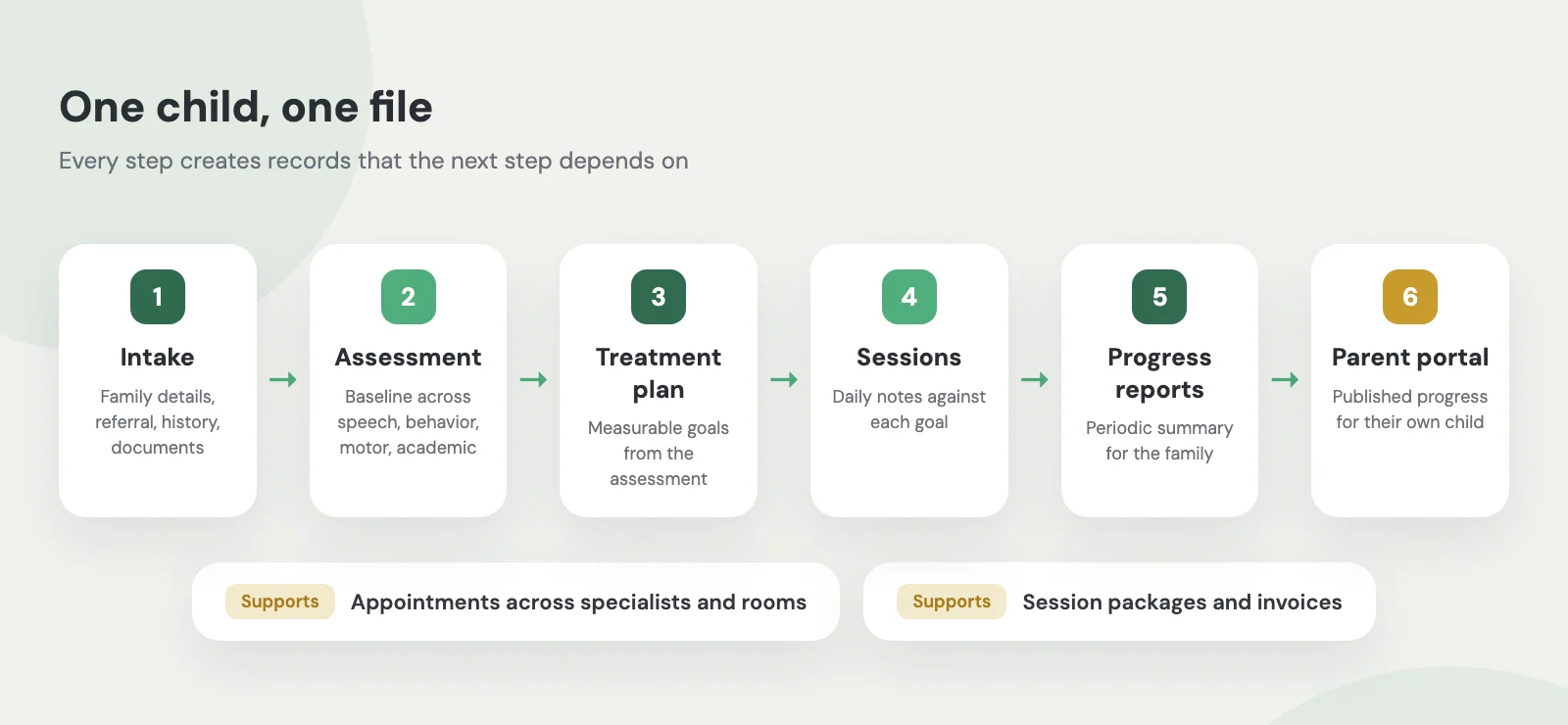
- Intake: the family's details, the diagnosis or referral, medical history, and documents.
- Assessment: a baseline across the relevant areas (speech, behavior, motor, academic), repeated at reassessment.
- Treatment plan or IEP: measurable goals that come from the assessment. (If you need help here, see our guide to writing measurable therapy goals.)
- Sessions: daily documentation against those goals, by several specialists, often in two languages. (See how to write therapy session notes.)
- Progress reports: a periodic summary for the family and, sometimes, a school, a doctor, or an insurer. (See how to write therapy progress reports.)
- Parent communication: what the family sees between reports.
- Scheduling and billing: recurring appointments across specialists and rooms, session packages, invoices, and payments.
Most centers don't fail at any single step. They fail at the handoffs: the assessment lives in a Word file, the goals in a spreadsheet, the session notes in a notebook, and parent updates in WhatsApp. When a specialist leaves or a parent asks "is my child improving?", nobody can answer quickly.
So the first test for any software is simple: does it connect these steps into one child file, or does it just digitize each one separately?
What Makes the UAE Different
Most "best software" lists are written for the US or the UK. A few things change the decision for a center in the UAE.
Two languages, in both directions
Many UAE centers have Arabic-speaking families and an international team of specialists, some of whom work only in English. That means you need more than a translated menu:
- Staff should be able to work in English while a report goes to the family in Arabic, or the other way round.
- Arabic must display right to left correctly, including in exported PDFs. Broken Arabic in a printed report is one of the fastest ways to lose a family's trust.
- Names, addresses, and notes should accept Arabic and English text without breaking search or sorting.
Package billing
Families in the region often pay for session packages (for example, 12 or 24 sessions) rather than single visits, sometimes split across installments and sometimes partly covered by insurance. Software built around per-visit billing for US insurers usually forces workarounds. Ask to see how a package is sold, consumed session by session, and renewed.
Licensing decides your compliance needs
This is the part most articles skip, and it matters most. Special needs centers in the UAE are licensed in different ways, and the license shapes what your software has to support.
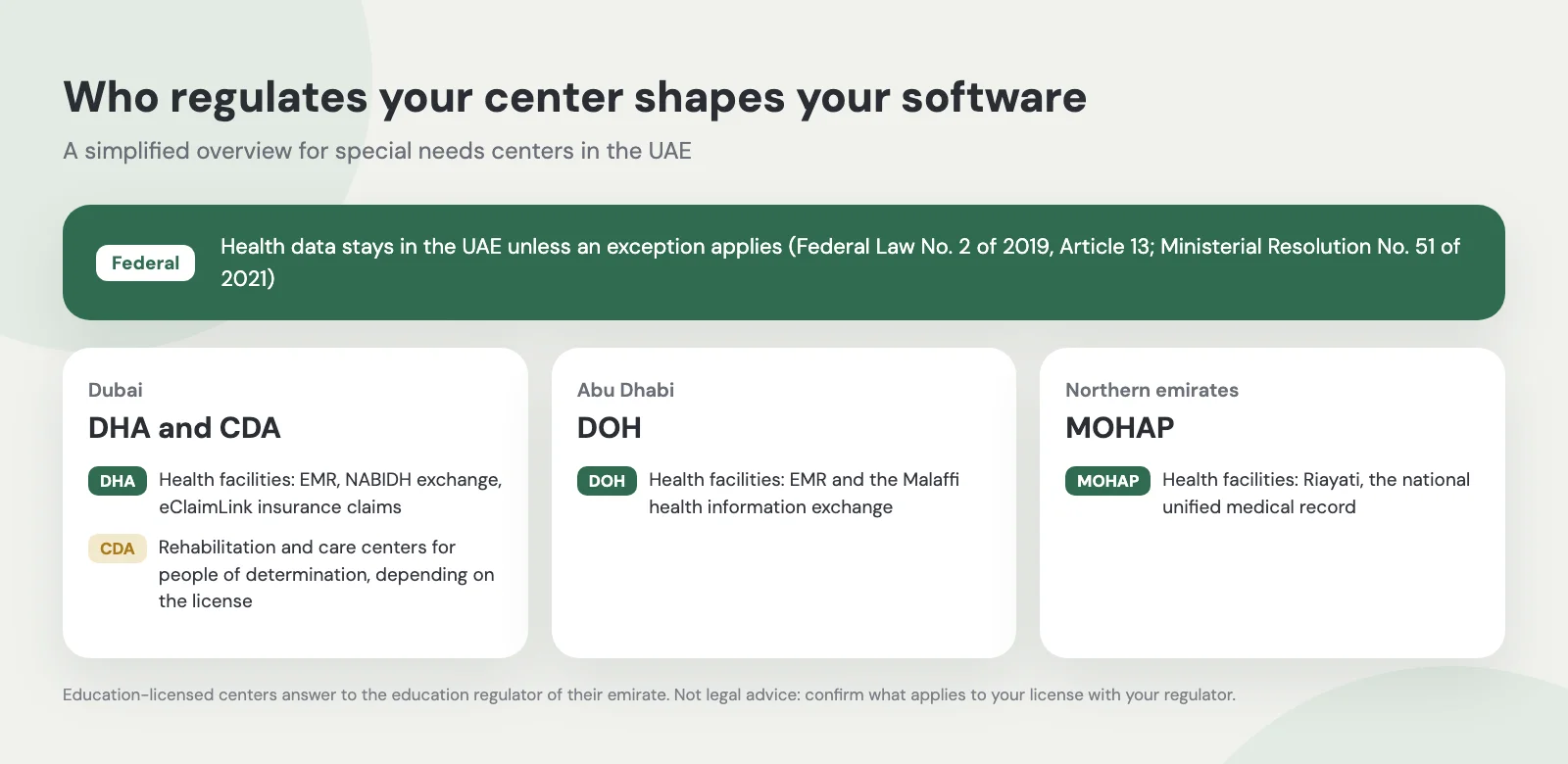
| If your center is... | Who usually regulates it | What it can mean for your software |
|---|---|---|
| A licensed health facility in Dubai (for example, offering speech therapy or occupational therapy as clinical services) | Dubai Health Authority (DHA) | Electronic medical records, connection to NABIDH (Dubai's health information exchange), and insurance claims through eClaimLink |
| A licensed health facility in Abu Dhabi | Department of Health Abu Dhabi (DOH) | Connection to Malaffi (Abu Dhabi's health information exchange) and insurance processes on DOH's systems |
| A licensed health facility in the northern emirates | Ministry of Health and Prevention (MOHAP) | Riayati, the national unified medical record platform |
| A rehabilitation or care center for people of determination in Dubai | Community Development Authority (CDA), depending on the license | Strong child records, plans, and reporting; usually not insurance e-claims |
| A center licensed for education or early intervention | The education regulator of your emirate, depending on the license | Individual plans, progress tracking, and reports for families and schools |
Two federal rules apply on top of this:
- Health data stays in the UAE by default. Article 13 of Federal Law No. 2 of 2019 on the use of ICT in health fields says health data may not be stored, processed, or transferred outside the UAE unless an exception applies. Ministerial Resolution No. 51 of 2021 lists those exceptions (summary by Baker McKenzie).
- Other personal data falls under the UAE's data protection law (Federal Decree-Law No. 45 of 2021). Health data that is regulated by its own legislation, such as the law above, is excluded from it.
The three health information exchanges are also being linked to each other (DOH announcement), which is one more reason to choose software that can keep structured clinical records.
This is a practical summary, not legal advice. Licensing categories overlap, and requirements change. Confirm what applies to your license with your regulator before choosing software.
The practical takeaway: ask every vendor which license types they support, and ask for proof, not a yes. A vendor that can't tell you where your data is hosted, or what "connected to the health information exchange" means in their product, has probably not done it.
12 Questions to Ask in Every Demo
Demos are designed to look good. These questions are designed to show you what happens on a normal Tuesday at your center. Bring a real (anonymized) case and ask the vendor to walk it through.
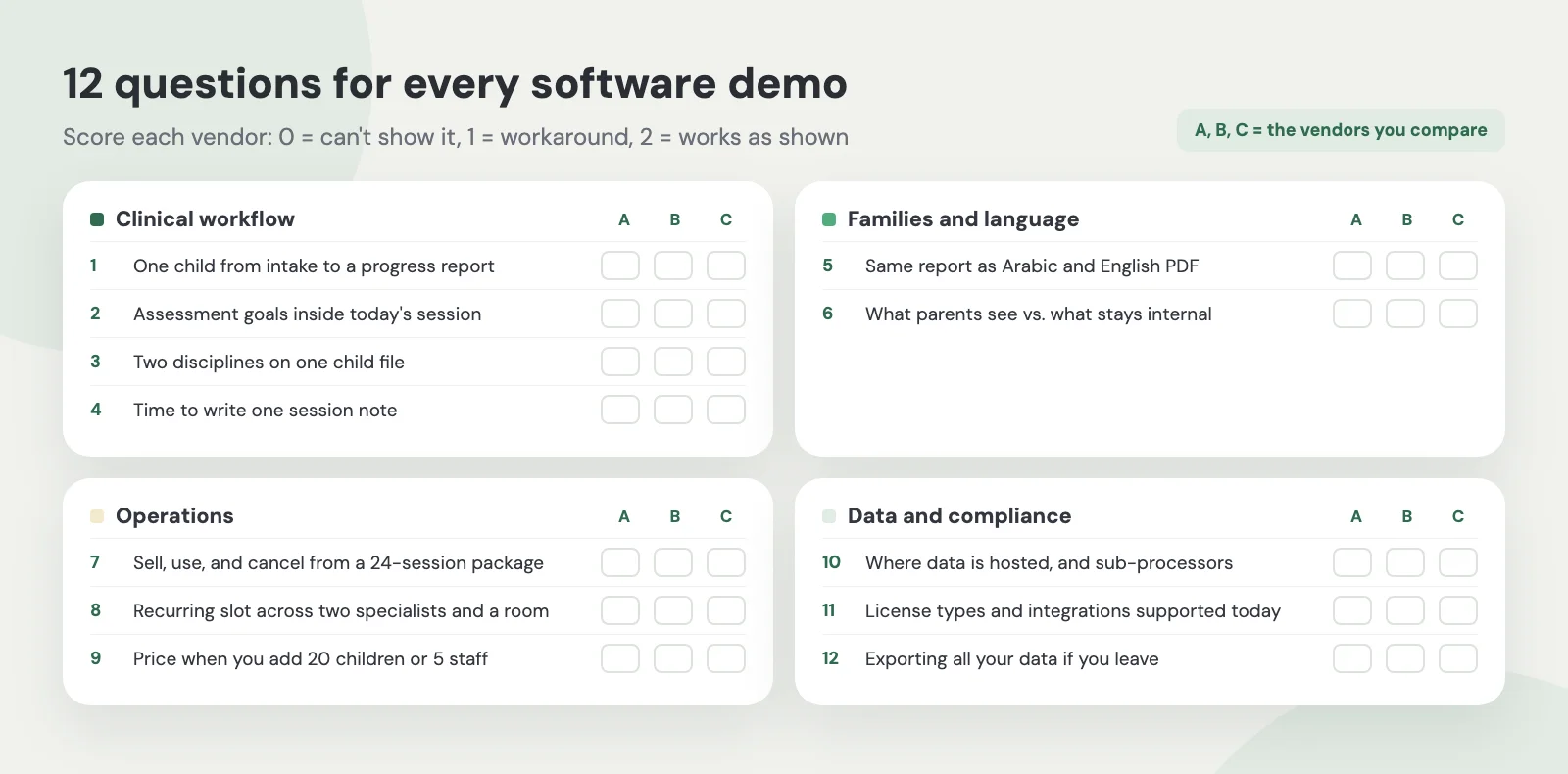
Clinical workflow
- "Show me one child from intake to a progress report." If the vendor has to switch between disconnected screens or export to Word in the middle, you will too.
- "How does a goal from the assessment show up in today's session?" Goals should be selectable in the session, with the measure and level of support recorded against each one.
- "Can two specialists from different disciplines work on the same child without overwriting each other?" Multidisciplinary centers need shared files with clear ownership.
- "How long does a session note take?" Ask a specialist on your team to try it. If documentation takes longer than the gap between sessions, it won't get done properly.
Families and language
- "Show me the same report in Arabic and in English, exported as PDF." Check the Arabic carefully: direction, numbers, and mixed Arabic-English lines.
- "What exactly does a parent see, and what stays internal?" Families should see their own child's published progress, not internal notes and not other children.
Operations
- "Sell a 24-session package, use 3 sessions, cancel one, and show me the balance." This one test reveals most billing problems.
- "Schedule a recurring weekly slot across two specialists and one room." Then move one session and see what breaks.
- "How does pricing grow when we add 20 children or 5 specialists?" Some tools charge per staff seat, some per student band, some per active child. Model your next two years, not this month.
Data and compliance
- "Where is our data hosted, and which sub-processors can access it?" Get the answer in writing, and check it against the federal health data rule above.
- "Which license types and health authority integrations do you support today, not on the roadmap?" Ask for a reference center with your license type.
- "If we leave, how do we get all our data out?" You should be able to export your center's records in a usable format, at any time.
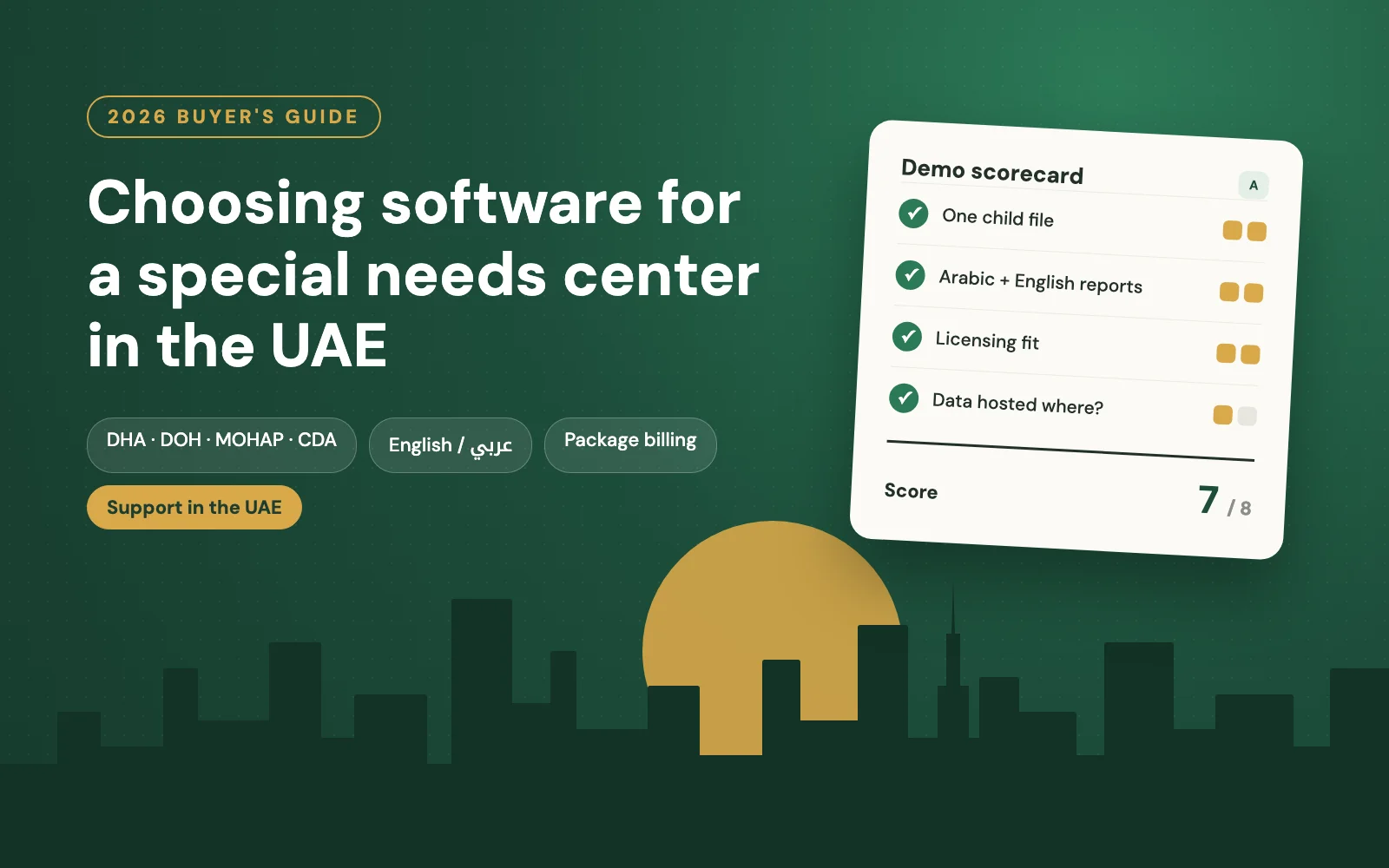
Score each vendor from 0 to 2 on each question: 0 if they couldn't show it, 1 if it needs a workaround, 2 if it works as shown. As a rule of thumb, a total under 16 out of 24 means your team will spend a lot of time on workarounds.
The Main Options, Compared Honestly
There are five broad types of software that UAE centers end up using. Here's how they compare, based on what each vendor publicly states as of October 2026. Features and prices change, so check each vendor's site before deciding.
| Option | Built for | Strengths | Watch out for |
|---|---|---|---|
| Spreadsheets, shared drives, and WhatsApp | General use | Free, familiar, flexible | No single child file, hard to report on, child data scattered across personal phones |
| General clinic or hospital systems (EMR/HIS) | Medical clinics and hospitals | Health authority integrations, insurance claims | Built around doctor visits, not goals and sessions; progress reports and parent views are usually weak |
| International ABA and therapy platforms (for example, CentralReach) | US-style practices, especially ABA | Mature data collection and large-scale features | Built around US practice and insurance billing; check Arabic support, local billing, and data hosting carefully; support is online only, with no team based in the UAE as far as we know |
| Arabic special education platforms (for example, Ynmo from Saudi Arabia, Taheel Web from Jordan) | Arabic-speaking special education and rehabilitation centers | Arabic-first, IEP and goal tools. Ynmo advertises a bank of 3,000+ goals; Taheel Web publishes annual plans priced by number of students | Check UAE health licensing support, insurance workflows, and where data is hosted; support is online only, with no team based in the UAE as far as we know |
| Therapy center management tools for autism centers (for example, TherapEZ, based in India) | Autism and therapy centers | Scheduling, documentation, progress reporting, and family communication in one place | Check Arabic support, UAE data hosting, and published pricing; support is online only, with no team based in the UAE as far as we know |
| Aghsan (my company, founded in Dubai in June 2026) | Special needs and therapy centers in the UAE and the Middle East | One child file from intake to reports, customer support from a team based in the UAE (not only online), Arabic and English, package billing, parent portal, full EMR for UAE centers | A young company: ask for a reference center close to yours and test it on a real caseload during the trial |
Several UAE centers have told us that remote-only support was a real problem for them: when billing breaks on a busy morning, a ticket queue in another time zone isn't enough. Ask every vendor where their support team is based and whether anyone can come to your center.
When another option is the better choice
I'd rather you pick the right tool than pick ours for the wrong reasons:
- You're a large ABA organization billing US insurers or working to US-specific protocols: a US-built ABA platform is designed for exactly that.
- You mainly want a very large ready-made goal and curriculum bank in Arabic, more than daily operations: Ynmo's 3,000+ goal bank is larger than ours today (Aghsan's bank has 1,300+ goals and is growing).
- You're a hospital or a multi-specialty medical clinic where therapy is a small department: your main hospital system may matter more than a dedicated therapy tool.
- You have fewer than ten children and one specialist: a well-organized spreadsheet and a secure shared folder can work for a while. Move to software before you hire your second specialist, not after.
What It Really Costs
Pricing models differ more than prices. Here are the three you'll see most often:
- Per staff seat: you pay for each user account. Cheap with a small team, expensive when you add receptionists, supervisors, and part-time specialists, and it discourages giving everyone access.
- Per student band or tier: you pay a flat fee up to a number of students (for example, Taheel Web lists annual plans of about AED 331, AED 1,065, AED 5,509, and AED 14,690 by number of students, converted from the USD prices on its pricing page in September 2026). Predictable, but check what happens when you cross a band.
- Per active child: you pay for each child who actually received services that year. Aghsan uses this model: AED 147 per active child per year in the UAE (equivalent to USD 40), with unlimited staff and parent accounts and every feature included (full pricing).
A worked example for a center with 60 active children and 15 staff:
| Pricing model | What drives your cost | What to model |
|---|---|---|
| Per staff seat | 15 staff, plus every new hire | Seat price × staff, including part-time and reception |
| Per student band | 60 children falls into a band | The next band's price when you grow to 80 or 120 |
| Per active child | 60 children | 60 × AED 147 = AED 8,820 per year on Aghsan, whatever the team size |
Software is rarely the biggest cost in a center, though. The bigger cost is staff time lost to duplicate documentation and to rebuilding reports by hand. If you want to see how documentation time affects your margins, try our free therapy center profit calculator.
How to Switch Without Disrupting Your Center
Centers often delay switching because they are afraid of losing records or upsetting families mid-term. A staged 30-day plan avoids both:
- Week 1: set up and import. Add your specialists, rooms, and services, and import active children. Don't import years of archive on day one. Start with what you use every week.
- Week 2: run one team in parallel. Pick one discipline (for example, speech therapy) and have them document every session in the new system while keeping the old method as a backup.
- Week 3: move scheduling and billing. Sell and track new packages in the new system. Keep old packages in the old system until they run out.
- Week 4: first reports and parent access. Produce one round of progress reports from the system and invite a few families to the parent portal. Collect their feedback.
At the end of the month, compare: time spent on notes, time to produce a report, and how many parent questions you received. If those numbers didn't improve, that software isn't right for you, and you've learned it during a trial instead of a contract.
Red Flags
- The vendor can't show a live product, only slides or a video.
- "Arabic support" turns out to be a translated menu, with reports that only export in English or with broken Arabic.
- Hosting location and sub-processors are vague or "confidential".
- Pricing is only available after several sales calls, and it changes depending on who you ask.
- Core features you need (parent portal, reports, billing) are paid add-ons.
- There is no way to export your data without asking the vendor.
Where Aghsan Fits
We built Aghsan for exactly the center described in this article: a center in the UAE or elsewhere in the Middle East with several disciplines, Arabic- and English-speaking families and staff, and package-based billing.
- One child file: child records, assessments, treatment plans, goals, sessions, and progress reports are linked, so session data flows into reports instead of being retyped.
- Arabic and English: the full interface works in both, right to left and left to right.
- Operations: appointments across specialists and rooms, and billing with session packages.
- Support in the UAE: our team is based in Dubai, so support isn't limited to online chat and email.
- Families: a parent portal where parents see only their own child's published progress.
- Full EMR for UAE centers: structured diagnoses and coding, clinical history, connection to the UAE health information exchange, and insurance e-claims. This is currently available to centers in the UAE only.
- AI help, with specialists in control: Aghsan drafts session notes and progress reports and suggests goals from a bank of 1,300+ goals. Specialists review every draft, and clinical data is never used to train AI models.
- Data: daily backups, encryption in transit, and an export of your center's data whenever you ask. Where data is hosted and which sub-processors are involved is set out in our privacy policy.
- Pricing: AED 147 per active child per year in the UAE, one plan, unlimited staff and parent accounts, onboarding and data import included, and a 30-day free trial for centers.
Take the 12 questions above into your demo with us, and with everyone else you're considering. If we can't answer one of them well, you should know that before you decide.
Frequently asked questions
What is the best software for a special needs center in the UAE?
The best fit is software that keeps one file per child from intake and assessment through goals, sessions, and progress reports, works properly in Arabic and English, handles session packages and invoices, gives parents a view of their own child's progress, and matches how your center is licensed. Use the 12 demo questions in this guide to compare vendors on those points.
Does special needs center software in the UAE need to connect to NABIDH, Malaffi, or Riayati?
It depends on your license. Centers licensed as health facilities by DHA, DOH, or MOHAP may need electronic medical records and a connection to the relevant health information exchange (NABIDH in Dubai, Malaffi in Abu Dhabi, Riayati for MOHAP). Centers licensed for rehabilitation or education usually don't. Confirm the requirements for your license with your regulator.
Can a UAE center store child health data on servers outside the UAE?
By default, no. Article 13 of Federal Law No. 2 of 2019 says health data may not be stored, processed, or transferred outside the UAE unless an exception applies, and Ministerial Resolution No. 51 of 2021 lists those exceptions. Ask every vendor in writing where your data is hosted and which sub-processors can access it.
How much does special needs center software cost in the UAE?
It depends on the pricing model: per staff seat, per student band, or per active child. Aghsan charges AED 147 (USD 40) per active child per year in the UAE with unlimited staff and parent accounts, so a center with 60 active children pays about AED 8,820 a year. Model your costs for the next two years of growth, not just today.
How long does it take to switch a center to new software?
A staged plan of about 30 days works for most centers: set up and import active children in week one, run one team in parallel in week two, move scheduling and billing in week three, and produce the first reports and invite families in week four.